


About team RL
● Mission:
We develop reinforcement learning (RL) methods for adaptive decision-making and apply them across diverse domains, with personalized diagnostics based on brain connectivity and medical signals as our primary application
● Scope:
Our diagnostic research uses RL to account for inter-individual differences in brain functional connectivity (FC) and mitigate site-specific noise in multi-site fMRI, enabling robust and generalizable diagnostics
● Goal:
Our goal is to build a generalizable RL decision-making framework, demonstrated through a clinically scalable diagnostic system that adapts to patient-specific variability in medical patterns and balances multiple diagnostic objectives for individualized care
● Future Direction:
Beginning in 2027, we will extend our RL decision-making framework into robotics, focusing on rubric-based reward design and post-training of vision-language-action (VLA) models for adaptive robotic manipulation
Available internship topics
● Conditional Diffusion Modeling for Personalized Medical Signal Synthesis and Reward-Based Quality Evaluation
● Simulation and Evaluation of Multi-Agent Reinforcement Learning Models for Role-Based Diagnostic Task Allocation
● Reinforcement Learning Fine-Tuning of Vision-Language-Action Models for Robotic Manipulation
● Rubrics-as-Rewards (RaR) for RL Post-Training of Vision-Language-Action Models in Robotic Control
Our research topics
Personalized Decision Making with Reinforcement Learning
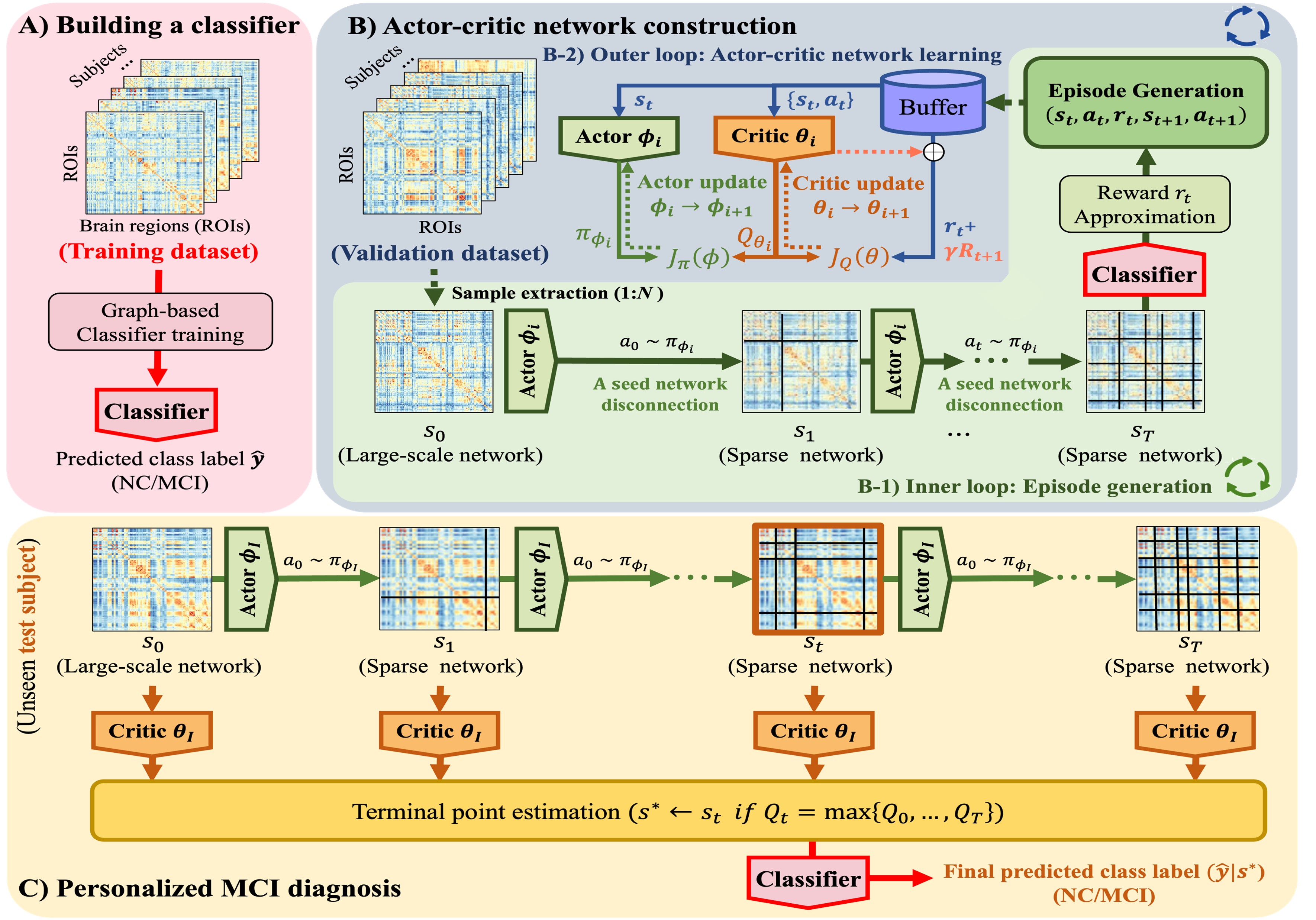
● Our team is using reinforcement learning to support optimal decision-making in personalized and complex medical situations. By continuously learning from patient-specific data such as ROI and EEG-based traits, we generate insights that contribute to more efficient care approaches and improved patient outcomes.
Related publications
[Under review] Integrated Ensemble Reinforcement Learning with Unified Decision for Personalized Mild Cognitive Impairment Diagnosis
[ESWA'26] A Hierarchical Reinforcement Learning Approach to Personalized Decision-Making for Brain Connectivity Segmentation
[JBHI'24] Sparse Graph Representation Learning based on Reinforcement Learning for Personalized Mild Cognitive Impairment (MCI) Diagnosis
Feature Selection with Multi-Agent Reinforcement Learning
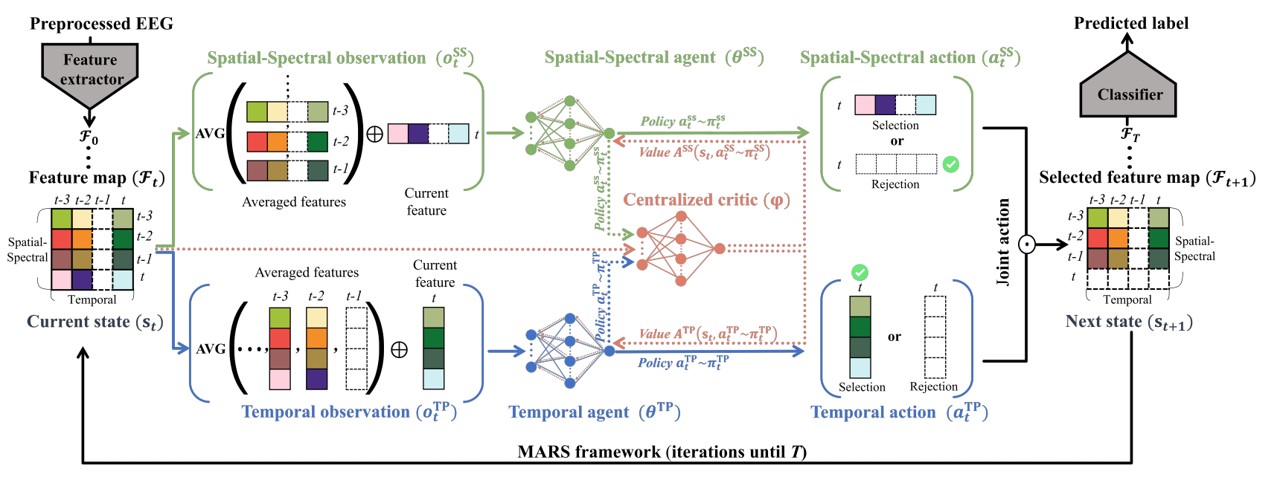
● We are developing a multi-agent reinforcement learning framework that identifies the most relevant features in medical datasets. This approach enhances diagnostic accuracy and model efficiency by selecting critical biomarkers through agent collaboration.
Related publications
[ICASSP'26] Adaptive Static-Dynamic Functional Connectivity Feature Fusion for Diagnosis of Mild Cognitive Impairment
[ICASSP'26] Reinforcement Learning with Multi-Objective Rewards for Functional Connectivity Augmentation
[ICEIC'26] Adaptive Reward Weighting via Reinforcement Learning for Major Depressive Disorder Diagnosis
[IEEE Trans. SMC'24] MARS: Multi-Agent Reinforcement Learning for Spatial-Spectral and Temporal Feature Selection in EEG-based BCI
Agentic AI with Reinforcement Learning
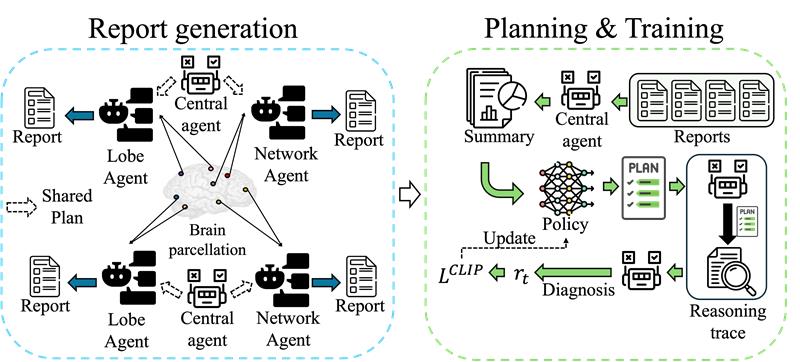
● We investigate an intelligent system that enables Agentic AI to autonomously set goals and explore problem-solving strategies across diverse domains by leveraging a reinforcement learning–based decision-making framework.
Related publications
[ICEIC'26] Agentic Brain: Agentic AI System for Autonomous Diagnosis of Functional Connectivity Network